NEWSLETTER
Issue 36 June 2009
WEST MIDLANDS BRANCH
DIARY DATES
NEXT BRANCH MEETING
Monday 22
nd
June at Hill Close Gardens Visitor
Centre, Bread and Meat Close, Warwick CV34 6HF.
From 10.00am. See meeting Agenda for further
details.
BRANCH MEETINGS 2009
Branch meetings take September and November
2009 and March 2010. Actual dates will be confirmed
later.
Herefordshire if possible on this day – so if you are
able to volunteer it would be much appreciated.
Finally, in April, I was also invited by the RICS
to present their conservation awards at a formal
dinner at the Birmingham Botanical Gardens.
Unfortunately (for me) I was unable to attend as I was
returning from Italy that night but Philip Belchere as
Vice Chairman was able to go and fly the flag for
IHBC. It is good to be asked to such events as your
chairman as I do genuinely see them as recognition of
the role that we play and confirmation that we do have
a voice in the region with the other big players. When I
started as chairman one of my (largely unspoken)
aims was to try and make more effective contact with
bodies such as RIBA and RICS and hopefully
attendance at such events means that we are
achieving some measure of success.
My trip to Italy was hugely enjoyable but not
without a tinge of regret, again, that in so many ways
we are far behind our continental neighbours in terms
of successful conservation. I am aware that some
countries see our “system”, our legislation, as
enormously effective – and as far as buildings are
concerned – we are pretty successful. But in terms of
townscapes we lag woefully behind.
In the space of twelve months I have coursed
through cobbled courtyards in Krakow and marvelled
at marble in Pisa, Florence and Bologna. I have
traipsed over enormous herringbone slabs of black
basalt and grey granite, and tiny cobbles that have
taken pedestrian and vehicular traffic for hundreds of
years. I have walked in the sun and the rain, in
daylight and at night time in the light from carefully
crafted cast iron streetlamps – testament to the skill of
the patternmakers and iron foundries. All bear witness
not only to the practical durability and longevity of
quality materials but also to the philosophies of the
guardians of these historic continental city centres.
Historic streets are not ripped up in the latest dash to
spend the latest “European Grant” monies on another
transient flight of fancy designed by a landscape
architect striving to be creative with concrete. Historic
lamp standards aren’t ripped out to be replaced with
galvanised steel “Heritat”. And crucially there aren’t
armies of ambulance-chasing, commission-conscious,
legal advisers waiting on every street corner to fight
your compensation case in the unlikely event that you
slide on a slippery slab, or trip on tilted granite.
CHAIRMAN'S COLUMN
Dave Burton-Pye
AWARDS & OBSERVATIONS
I’d like to think that somewhere along the line IHBC is
increasingly recognised locally as well as nationally
for the contribution that our members make to the
conservation cause and three recent events have
brought this to mind.
In February, I attended a MADE event at the
Custard Factory in Birmingham where the head of the
RIBA West Midlands region suggested to me that
IHBC might like to play a part in their regional
architectural awards and this is something that branch
officers will consider (I think I’ve read on the IHBC
website that one of the other regions has been
similarly involved elsewhere)
Then in March I was invited as the IHBC
representative to an opening day at Croome Park in
Worcestershire to celebrate the joint work by the
National Trust and Natural England to restore this
enormously important landscape. It is Lancelot
‘Capability’ Brown’s first complete design and here he
designed not only the park, but also remodelled the
house and is thought to have designed the Rotunda.
The change from intensively farmed arable land back
to permanent grassland has transformed the
landscape and enabled Brown’s original vision to be
much better appreciated. Public access has been
greatly increased and natural habitats have been
much improved. After I spoke to their regional director
at Croome, Jez Brotherton, Natural England’s Historic
Environment Specialist, who will be a speaker at our
September meeting. We do need a volunteer to host
this meeting and I am very keen for us to visit
Newsletter 36
page
1

In essence its further confirmation, if ‘twere
needed, that we need to develop a better appreciation
of our heritage in its widest sense, and make a better
job of preserving areas as well as buildings. All of
which has been said before by many others – it’s just
that visits abroad keep reinforcing my view about the
calamity of the compensation culture and its
devastating effect on culture as a whole.
See you in Warwick.
breadth and depth of his practical knowledge, in terms
of what was needed, but also of his wise philosophical
approach regarding what should be done.
I think that both of these qualities were
encapsulated in his involvement with the restoration of
the statue of Hercules in Shrewsbury. This larger than
life lead figure was originally considerably larger in
some anatomical aspects than most males, but at
some point he had been severely emasculated –
though whether through envy or prudishness is a little
unclear. In advising on the restoration Mickey
apparently said that “Once it's all done he’ll be back to
his former glory. You never know we might even get a
smile out of him.” Lot’s of us will remember getting
smiles out of Mickey.
In the guise of The King Partnership, Mickey
and Mary were involved in two conservation projects
in South Staffordshire in recent years and I was
extremely impressed on both occasions by the
extensive research and cogent explanations that they
gave for the history and evolution of both a farmhouse
and a water mill as part of the planning applications
submitted to my authority. In essence their thorough
approach enabled informed decisions to be taken and
I’d like to think that so many times this is at the heart
of what we all do – or try to do.
Bizarrely I saw Mickey and Mary a couple of
years ago when I was walking in the Lake District.
Having climbed Mont Blanc in 2006 I thought that
camping might be worth a wiz and bought a small
lightweight two man tent that myself and my climbing/
walking mate took to the Lakes for a weekend. On our
return to Braithwaite, Alan and I were almost back at
the car when I happened across Mickey walking back
to his holiday accommodation with his Sunday papers.
He insisted that we come in and say hello to Mary –
which we obviously did before making our way back
home. On another, more recent, occasion I attended
an evening meeting of the Shropshire architects group
to hear a talk by Andrew Arrol about his work at York
Minster. I had gone with my wife and an architect
friend and after the presentation, we walked back to
the car with Mickey and Mary. I’ve seen both of these
friends recently and told them about Mickey’s death
and found it quite remarkable that both had a clear
recollection of him – but both based on only the most
fleeting of conversations with him.
And that’s how I want to finish this tribute.
Mickey King made an impression not just on those
who knew and worked with him professionally, but
also on people to whom he was unknown. He is sorely
missed.
EDITORIAL
Technical Articles Wanted
Sorry, but Issue 35 used up the last technical article
provided for us by Charles Shapcott on matters
structural. So it is up to you readers out there to
provide your West Midlands Regional IHBC
Newsletter with cutting edge information on ‘how to do
it’. Just send me an Email with a Word attachment,
and jpeg illustrations. I will do the rest.
Travel News
I’ve been on my travels again, both to Ireland and
USA, and have various things to contribute. But! But I
do need your feedback on what I write so that if it
doesn’t ring any bells or speak to you in any useful
way I can leave it out in future.
The Editor
PEOPLE 1
At the 2009 AGM the existing branch officers were
returned en bloc, but with the very welcome addition
of
Jan Ratcliffe
as our new Branch Treasurer in
succession to
Mizzy Marshall.
PEOPLE 2
IN MEMORY OF MICKEY KING
Dave Burton-Pye
In my own small way I’d like to put together a few
words in tribute to a man who left a real mark and
made an enormous contribution to the conservation
cause. I can’t remember when I first met Mickey, only
that it was many years ago, long before ACO had
morphed into IHBC, and that he was an exceedingly
vocal contributor to any group discussions. Whatever
anyone else had experienced, Mickey seemed to
have been there. He “had the T-shirt”. He certainly
played a hugely influential role in Liverpool as an arch
exponent of the regeneration through conservation
message, and part of his philosophy about
conservation, and indeed conservation officers, came
through strongly and clearly in an article that he wrote
for the north west newsletter in late 2007. In fact
Mickey’s messages usually came through loud and
clear - a point made exceptionally well in one of the
touching and emotional eulogies given by a close
friend at his funeral. It is a measure of the mark of the
man that the large church was filled with those from all
aspects of his life who came to pay their respects.
You will all know that he regularly attended
our branch meetings here in the West Midlands and
crucially he had something to say. You may have
agreed with him, you may have opposed his views –
but you always knew what Mickey thought about an
issue. Many a time I argued with him during our
meetings, but knew that we could reach some sort of
compromise over a pint during lunch. Those who
worked with him were conscious not just of the
BRANCH MEETING
Day Theme :
GRANT-ENABLED REGENERATION
IN NORTH SHROPSHIRE
9th March 2009
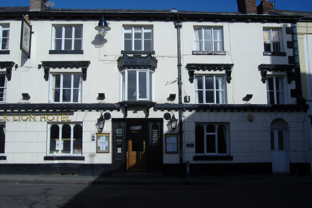
The 9th March Branch AGM and Meeting took place
at the Black Lion Hotel in Scotland Street, Ellesmere,
in the north west of Shropshire. The meeting was
hosted by
Philip Belchere, Ruth Hitchen
and
Rachael
Parry
of North Shropshire District Council. Special
thanks to them for arranging an interesting and
informative day. North Shropshire DC lost its identity
by merger into Shropshire unitary authority at the end
of this March.
The day included presentations on (1) current
grant schemes run by North Shropshire DC; and (2)
interpretation of Ellesmere with a special eye to
visitors to the Mere, a popular tourist attraction.
Newsletter 36
page
2
The afternoon involved a walkabout focussing
on visits to the
Mere Visitor Centre
and the
British
Waterways Maintenance Yard
on the Shropshire
Union Canal main line just outside the town. In both
locations grant-aided work was on site, and
participants had the opportunity to enter and inspect
both sites.
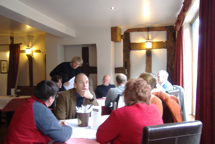
Lunch was taken at the Black Lion Hotel,
which members had almost entirely to themselves.
The dining area enabled us to see more of what was
clearly a fairly complex multi-period building.
VIEW OUT OF THE WINDOW
9th March 2009
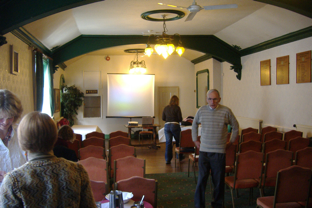
The Branch Meeting and AGM took place in the first
floor club room on the first floor of a rear wing. Access
was off the winding but low main stair of the
Black
Lion
, with a nice early C19 balustrade and an empty
wall niche on the turn.
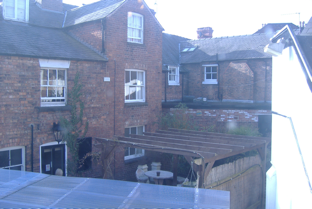
Out of the Black Lion Club Room window
Black Lion street frontage
The Club Room had experienced the insertion
of an end bar and an end broom cupboard in the C20
but was still a substantial early-mid C19 room with
original mouldings, glazing, mirrors, strapwork plaster
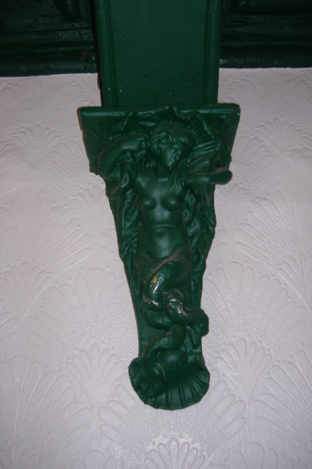
panels and tie beams supported on ornate carved
wood corbels, featuring masks, merpeople and eagles
(or were they wyverns?). All the detailing was thickly
coated in paint, the top coat being a glossy green.
Application of a paint-stripping poultice promised to
reveal some interesting carving.
Mermaid carved wood corbel, Club Room
The end wall of the dining area retained part
of a timber truss. This, together with the low ceilings
and the presence of boxed-in beams indicated that
the Black Lion was a partly timber-framed building
with an early Victorian frontage and rear wing. A
suitable candidate for an archaeological investigation.
And a hint that the apparently Georgian character of
the town centre represented a re-facing rather than a
re-building.
General view of the Club Room
The view out of the windows was on to the
rear of adjoining Scotland Street properties, and
overlooked the modern corrugated plastic of a
smokers’ shelter in the yard below.
Dining Area of Black Lion with exposed timber framing
at back
Newsletter 36
page
3
INTERPRETING ELLESMERE
Philip Belchere
9th March 2009
The Mere after which Ellesmere had been named had
been a long-established visitor attraction. However,
visitors brought all their necessities with them,
enjoyed the Mere’s amenities, and then went away
again without visiting the town, just up the road.
So
local businesses did not benefit significantly. The
District’s strategy was to ‘make the connection’
between Mere and town by establishing a series of
visitor trails, keyed to a limited number of view tables,
interpretation panels and themed sculptures that took
in the (very significant) local industrial archaeology as
well as the town centre itself and sites of special
Nature Conservation interest. Public sculpture was
being built up as a separate theme, there having been
an international sculpture project based locally that
had provided a small core of works as a basis for
more.
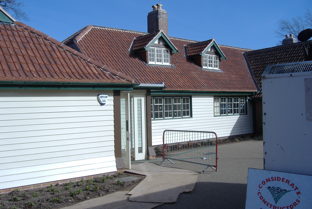
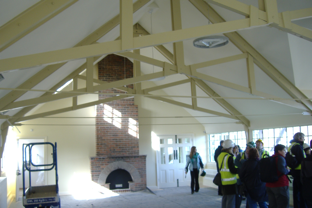
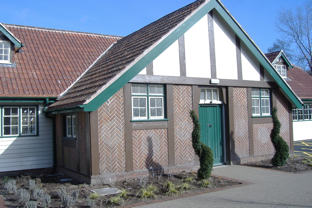
casement windows, including two dormers. It had
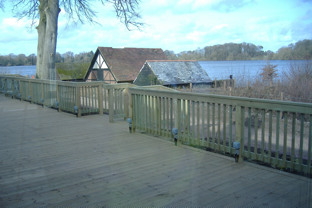
been repaired, refurbished and slightly extended,
overlooking and opening on to railed timber decking
facing the Mere. The main café area was an attractive
single space under a large, open, scissor truss roof.
The Mere Visitor Centre, Ellesmere
A grant aided scheme was on site refurbishing
the
Mere Visitor Centre
, with new landscaping on the
publicly accessible Mere shore, linked to a new car
park. This had attracted £1.6m
Parks and Gardens
grant funding.
Another future visitor attraction was the
British Waterways Maintenance Yard
, a remarkable
industrial and administrative complex dating from the
early 1800s. North Shropshire and other grant money
was being committed here to envelope repairs to
ensure continued survival.
An arm of the Shropshire Union Canal
terminated immediately adjoining the town. A new
Tesco supermarket was being built on an adjoining
site, and the District had already laid out and hard-
landscaped a public open space fronting the canal
arm. Planning permission had also been granted for a
commercial development adjoining Tesco, but this
was now ‘on hold’ as the Credit Crunch had destroyed
its potential profitability for the time being.
Visitor Centre café area
MERE VISITOR CENTRE
9th March 2009
The Mere is located immediately to the SE of the
town, with the A495 running along its SW shore. It is
the most famous of several meres in the immediate
area, owing their existence, very probably, to the
jumble of small local hills left behind by the last Ice
Age. The Mere was developed as a private amenity
by a local land-owning family, and only passed by
benefaction into the public domain during the C20.
The eastern shore remains part of a private park and
the north shoreline is now quite heavily wooded.
Wildfowl are conspicuous – perambulating geese
being an informal ‘traffic calming’ feature.
The publicly accessible part of the Mere is
now being radically refurbished with the aid of a Parks
and Gardens grant. At the time of the Branch visit, a
new hard-surfaced shoreside walk was in place,
flanked by a strip of soft landscaping between it and
the road. Further hard landscaping was in progress,
and the refurbishment of the largest existing building,
the café, advanced to the point of final finishes and
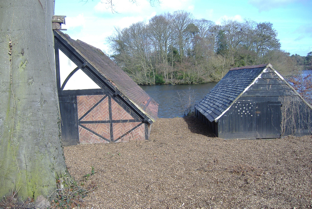
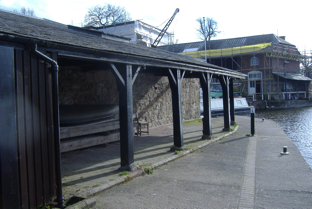
fittings. Three varied boathouses (one with an
elaborate late C19 tiled roof) had yet to be
refurbished. There was also a small
cottage ornee
in
the midst of the works area.
The café was an attractive 1930s building in
the ‘sports pavilion’ style, featuring both half-timbering
with herringbone brick nogging and shiplap boarding;
with a large steep pantiled roof and many multi-paned
Main frontage gable
Terrace overlooking the Mere – with boathouses
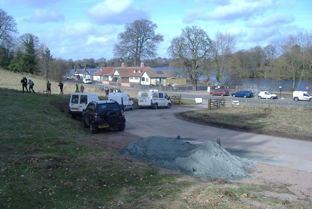
The project was intended to be up-and-
running for the 2009 visitor season. Amenities
Newsletter 36
page
4
included a new, secluded car park being created up a
ramp and behind banks on the opposite side of the
main road.
21st century engineering working methods without
significant alteration. BW has considered the
possibility of creating modern facilities close to the
site but any future development will need to be
sympathetic to the setting.
BW is considering appropriate future leisure-
focused uses of the buildings particularly in relation to
heritage and craft skills units.
On inspection, the Yard proved to be a major late
Georgian industrial and administrative site, with a
cluster of II* and II Listings.
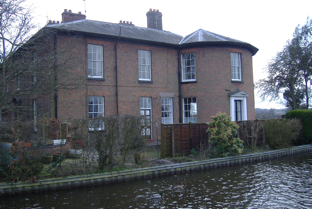
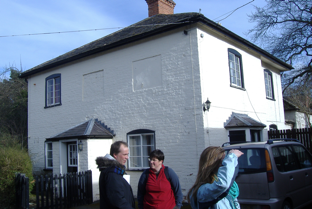
Most conspicuously sited is a two storey
managerial residence overlooking the 90-degree bend
in the Canal main line and the junction with the
Ellesmere town arm. The house features a two-storey
bow on the angle and sits within its own gardens.
Visitor Centre in its wider setting
BRITISH WATERWAYS
MAINTENANCE YARD
9th March 2009
Thank you to
Kate Lynch
, British Waterways heritage
adviser, for arranging access and a guided inspection.
Her site description follows:
Many maintenance yards survive in the BW Estate in
varying degrees of completeness. Ellesmere yard is
particularly significant because of its origins, c1800;
because of its traceable evolution; and because of its
high degree of completeness. There has been
continued use of the site for the past 200 years.
The site was developed from 1797, and
adequately mapped from 1839. The cottage, dry
dock, and a major part of the workshops date from
this time. The workshop range was extended and
altered in 1840-1 884, and the timber store, sawmill
and engine house built during the same period.
There was a major remodelling of the
workshops between 1884 and 1901, when the site
became a full-scale engineering works. The office and
store was part of this phase .
The site reached its peak of development after World
War I, by which time the canal’s requirements in iron,
timber and concrete were being produced with the aid
of additional cranes, saws and steam engines.
Since the 1940s, the site has been in slow
decline, with the loss of facilities (cranes, engines and
saws) and functions. The dry dock is the only element
still performing its original role. The buildings have
many minor defects, but there is no evidence of
deterioration sufficient to justify demolition, as all the
buildings have some statutory protection. The
buildings have survived partly because they are
useful, partly because they are adaptable. There is
therefore potential for their continuing use.
Some of the buildings are on the local
authority’s buildings at risk list. BW has secured
funding via North Shropshire District Council’s
Buildings at Risk fund to carry out some repairs to the
buildings. This consists of roof and brickwork repairs
and repairs to rainwater goods. We have received
listed building consent for the work.
British Waterways is considering various
options to secure the future use of the buildings at
Ellesmere Yard. (The dry dock is still used on a
regular basis for boat maintenance. Part of this
building is also used as British Waterways offices and
will remain so).
However many of the other buildings on the
site are now used as storage. They are not suited to
Managerial residence at canal junction
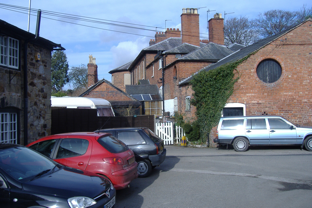
A range of service buildings including stables
continue the house west along the waterway frontage.
This range forms a flank to the road access to the
Maintenance Yard proper.
House stables seen from Maintenance Yard
At the eastern end of the yard is the Grade II
manager’s house. It is two storey brick that has
unfortunately suffered painting. Opposite, alongside
the Canal, is the Dry Dock. This has a two-storey east
face with the ground floor originally operating as a cart
shed. The cart sheds are now offices. The building is
executed in random stonework with rough ashlar
dressings. Roof is slate and hipped. On the south face
a top-hung sliding door faces on to an open dock.
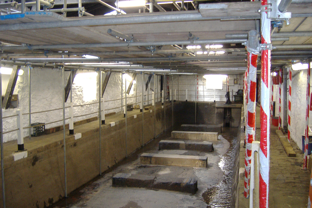
Below the door are stop planks. Inside is the dry dock
itself. The dock is in regular commercial use with a
schedule of bookings for underwater cleaning,
painting and repair of canal boats. The dock is
emptied through a sluice system that drains into local
streams at a lower level than the canal itself. The
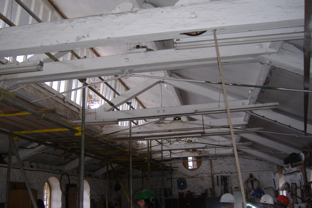
interior of the dock is an impressive space under a
complex open trussed roof.
Newsletter 36
page
5
industrial building with style, an eaves cornice
supporting a shallow hipped roof, and an open ground
floor with slender columns supporting a ship-lap faced
first floor with casement windows.
Maintenance Yard – Manager’s House. Oh dear,
painted brickwork!
Timber Store
The Yard itself has a modern tarmac surface
but contains, covered over, the remains of the on-site
narrow gauge railway and the one surviving large
crane (there originally having been two).
The largest range occupies the south side of
the yard, comprising the heavy timber shop nearest
the canal, with a ground floor forge and a first floor
woodworking shop next door. Construction is partly
random stone and partly brick, with some of the brick
panels set within timber framing. The first floor
carpentry shop has a splendid, almost full length
‘north light’ dormer.
Dock – inside view. Work in progress with scaffolding
Carpentry shop roof
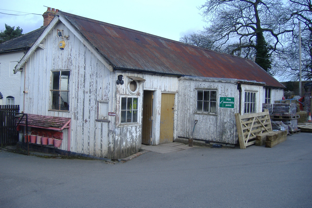
Waterside view of dock building
The entrance to the yard proper is flanked by
a timber hut of c1900 that once was the site
administration office, with a series of little exterior
features surviving from that use.
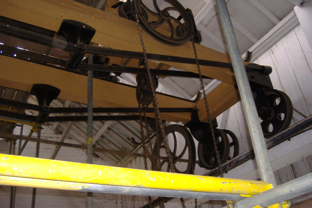
Overhead crane in Heavy Timber Store
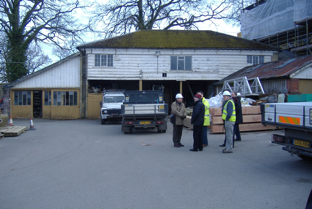
Current site works were concentrated on this
range, with either relaying or patching of the slate roof
(new Welsh and reclaimed respectively) with
repairing/reinstating flashing and rooflight glazing.
Repair specification had been prepared by
Purcell
Miller and Tritton
as consultants and was being
executed under the in-house supervision of BW’s
building surveyors.
Site administration office – many original features
On the east side of the Yard, away from the
water, is the Timber Store of c1840. This is an
Newsletter 36
page
6
A large proportion of the interest lies in the
fact that all three shops retain their original equipment,
as enhanced in the C19 and C20, with almost
everything operational and functional, including the
shaft and belt drive system, now powered by an
electric motor. There were full sets of tools and a
formidable gantry crane in the heavy timber shop.
Comments
This is clearly a major industrial history site, with a
large degree of survival from the turn of the C18,
representing on a small, provincial scale the first
phase of the Industrial Revolution.
Location is in easy walking distance along the
towpath from the town wharf. There is another
pedestrian access (which we used) through the nature
reserve on the other side of the main road from the
Mere Interpretation Centre.
It wasn’t clear (and I forgot to ask) whether
the main house was still owned by BW or had passed
into private hands. Whatever, it remains a major
element in the whole complex (irrespective of the fact
that Thomas Telford lived there for a little while) and
needs to be included in the interpretation packaging
even if not actually publicly accessible. A documentary
search could turn up some useful material.
ELLESMERE
9th March 2009
As I drove up the A528 the geography changed. The
road passed through and over a chaotic jumble of low
but steep little hills. Ellesmere itself is built on and
around some of these, with the Parish Church and the
former castle site on top. I looked on the internet later
and confirmed that this land formation – and no doubt
the meres too – was the end result of glaciation, being
the rubble left behind when the ice retreated.
As I arrived
earlier than expected, I was able to walk around
before the Branch meeting began. There was a
considerable amount of visibly C18 building, with, here
and there, hints of earlier half-timbering. Then, clear
signs of early/mid C19 prosperity presumably
connected with the canal and perhaps the railway.
With a further element dating from the late C19 and
early C20.
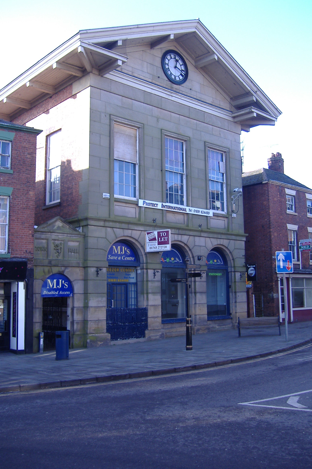
Particularly eye-catching was the Early
Victorian Italianate
Town Hall
, with bracketed eaves so
deep as to be almost Swiss in appearance. It seemed
to be vacant and in need of new uses and occupiers.
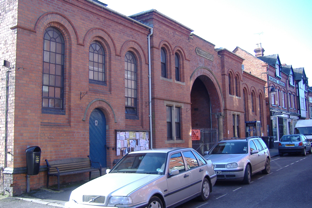
Up Scotland Street was the
Market Hall
of – I think –
1879. It had a brick frontage with a strongly
Romanesque central portal, with doors to match. It
remains in use and is open for trading on market days.
Also on Scotland Street was the
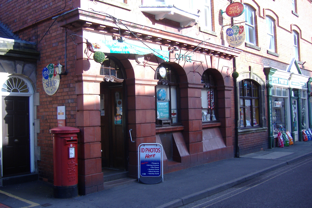
Post Office
–
Edwardian, with a terracotta-faced ground floor and its
original eccentric arts-and-crafts-classical glazing
bars.
Ellesmere Town Hall –in need of new uses
Romanesque style Covered Market
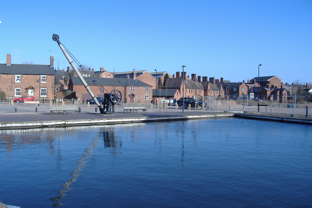
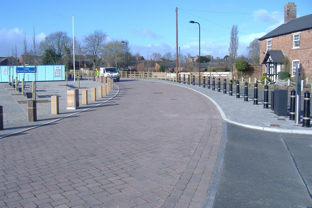
The Town Wharf was very much ‘work in
progress’ with a large newly-landscaped area abutting
the Canal arm. This featured a varied expanse of
concrete pavers and a surprising number of bollards –
both cast iron and timber, together with rows of newly-
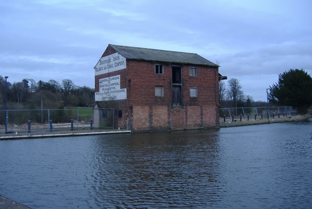
planted saplings. Awaiting attention was a derelict
waterside warehouse of the former Shropshire Union
Canal company, complete with painted signage.
A particular feature of the town centre was the
surprisingly number of large and impressive purpose-
built banks. Reflecting, I suppose, Ellesmere’s status
as a local ‘service centre’ as well as the prosperity
brought to the town by canal, railway and their
associated industries.
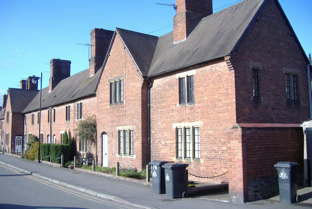
Gothic style almshouses near wharf
Newsletter 36
page
7
Wharf – derelict Shropshire Union warehouse
Swords Castle – where the money came from
Edwardian Post Office
Forest of bollards at the Wharf
SWORDS CASTLE
The Editor
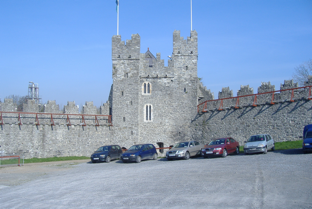
I had an extended weekend in Ireland during March,
which included an ‘at leisure’ day in Fingal County,
immediately north of Dublin City. The County Town of
Fingal is Swords. Swords has a castle. What I could
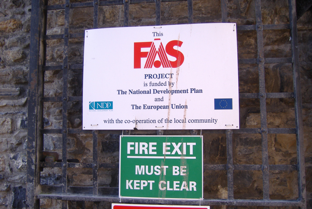
quite fairly describe as ‘restoration’ work was on site.
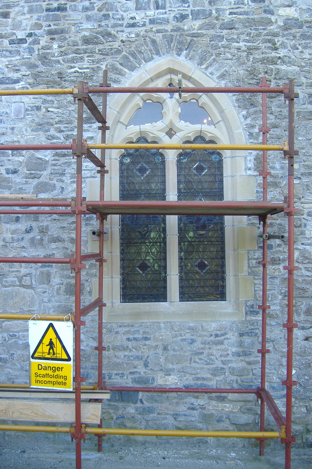
With, as a sign said, finance from the EEC. Ashlar
dressings were being 100% replaced. Masonry
consolidation seemed to be heavy-handed. And there
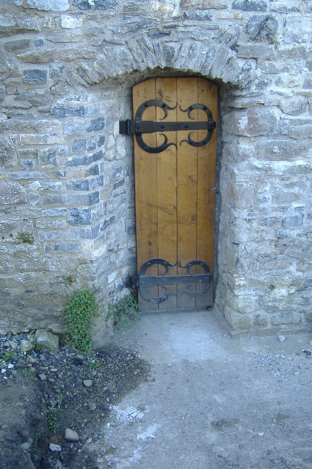
was a real amount of imaginative work. All the
doorway ironwork owed its design to the Celtic Revival
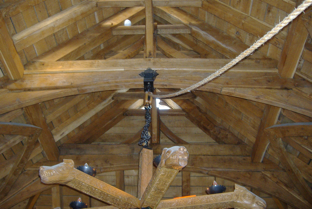
of the C19. The woodwork of the roof of the Great
Tower was great fun, being a full-blooded Hiberno-
Romanesque design owing virtually nothing to an
attempt at authenticity. The
overall result seemed to be great fun, but lacking
conservative retention of all salveable details,
particularly where ashlar masonry was concerned.
Swords Castle – 100% new window stonework
Roof timberwork in Great Tower, Swords Castle
Newsletter 36
page
8
Swords Castle – from bailey, Great Tower in centre
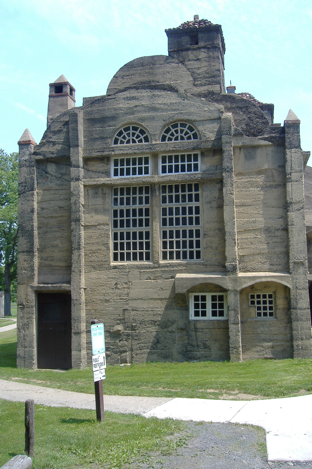
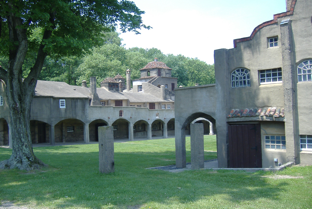
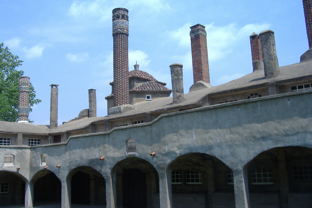
Moravian Tileworks – open cloisters around a ‘U’-plan
courtyard
MORAVIAN TILEWORKS,
Doylestown, Pennsylvania,
USA
The Editor
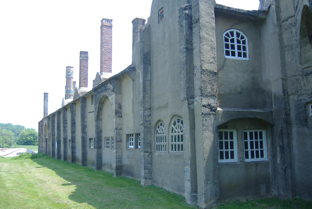
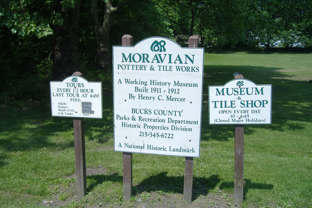
I spend three weeks in Pennsylvania, USA, in May.
On an expedition to the tourist honeypot of New Hope,
on the Delaware River, I encountered a quite
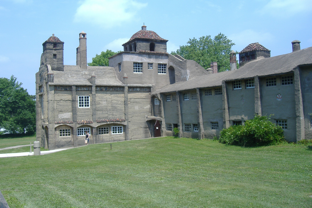
extraordinary building. It had been purpose built as a
tile works to the design of amateur architect Henry
Mercer 1911-12. To my European eye it was very
strongly evocative of Gaudi’s exactly contemporary
work in Catalonia, Spain, avoiding rigidly straight lines
and decorated with coloured tiling.
Tile-decorated chimneys
Interpretative captioning
With one significant difference. Gaudi used
brick and stone to create his curvilinear forms. In
Pennsylvania, Turner used 100% concrete, for both
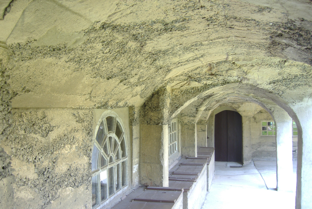
structure and facework. The concrete was very crude,
with massive amounts of aggregate. It had been laid
between shuttering as though it were pise. And the
vaulting of the open cloisters had been very crudely
shuttered, with a layer of Hessian between the
concrete and the shuttering.
The roof was of poured concrete, heavily
aggregate-dressed. Yet, despite being almost 100
years old, there was little sign of distress from the
severely ‘continental’ climate of very hot summers and
very cold winters.
The encrusting of the chimney shafts and caps
with decorative tilework were especially reminiscent of
Gaudi.
The whole building sat by itself in immaculately
cared-for parkland and was being operated as a
heritage site open to the public.
Cloister vaulting
General view
Newsletter 36
page
9
Exterior frontage wall piers
EDITOR'S SHOPPING LIST
Your Editor welcomes, for the next Edition of the
Newsletter (No 37), to go out in September 2009, the
following:
Personal news of moves, retirements, arrivals;
Copies of announcements and press releases;
Case Studies;
Letters;
Articles on Law and Techniques;
Book Reviews.
Material for inclusion in No 37 should,
preferably, arrive not later than the end of August
2009. Please contact your
Newsletter Editor
:
Peter Arnold, 16 Elmbank Road, Walsall WS5 4EL;
01922 644219;
pdarnold@care4free.net
PICTURE POSTSCRIPT
Swords Castle, modern door with Celtic Revival
ironwork. Also 100% repointing
The Waterfront, Ellesmere
Ellesmere – two boathouses on the Mere
Moravian Tileworks, Doylestown – end gable
Showing consecutive concrete pourings
Newsletter 36
page
10